

The PAMCET Learning Team is the institutional curriculum and content group behind course publishing on this platform. PAMCET (Professional and Academic Management Centre for Education and Training) is operated by Digitpen Hub Ltd, a company registered in Lagos, Nigeria. Courses credited to the PAMCET Learning Team are structured, organized, and published centrally by the platform rather than authored by a single named individual instructor — each course's syllabus, learning outcomes, and content are reviewed before publication under this institutional account. For questions about a specific course or to report a content issue, please use the platform's Help & Support or Contact Us pages.
CPA Exam Preparation: AUD (Auditing & Attestation)
Comprehensive preparation for the AICPA Uniform CPA Examination - Auditing and Attestation (AUD) Core section. Covers ethics, professional responsibilities (AICPA, SEC, PCAOB), quality management (SQMS 1 & 2), engagement acceptance and planning (AU-C 210, 300, 315), fraud risks (AU-C 240), internal controls (COSO, ITGC, SOC reports), audit evidence (AU-C 500), statistical sampling (Attribute, MUS, Classical Variables), substantive transaction cycle audits, subsequent events (AU-C 560), going concern (AU-C 570), audit opinions and CAMs (AS 3101), attestation (SSAE), review/compilation (SSARS), GAGAS Yellow Book, and Single Audit Act Uniform Guidance.

Course Overview
Comprehensive preparation for the AICPA Uniform CPA Examination - Auditing and Attestation (AUD) Core section. Covers ethics, professional responsibilities (AICPA, SEC, PCAOB), quality management (SQMS 1 & 2), engagement acceptance and planning (AU-C 210, 300, 315), fraud risks...
What You'll Learn
- Master the AICPA Code of Professional Conduct (ET Section 1.200), the Conceptual Framework for Independence, covered member rules, financial interests, and nonattest service constraints under ET 1.295.
- Comply with SEC and PCAOB independence standards and Sarbanes-Oxley Act (SOX) Title II mandates, including the nine prohibited non-audit services, audit committee pre-approval, partner rotation, and cooling-off periods.
- Implement the modernized System of Quality Management frameworks under SQMS No. 1 and SQMS No. 2, including firm risk assessment, resource allocation, and Engagement Quality Review (EQR) concurring approvals.
- Exercise professional skepticism and due professional care under AU-C 200 and maintain compliant audit documentation under AU-C 230 and PCAOB AS 1215 (assembly deadlines, retention, and contradictory evidence).
- Evaluate preconditions for an audit, formalize engagement letters under AU-C 210, communicate with predecessor auditors (AU-C 510), determine quantitative and qualitative materiality (AU-C 320 / SAB 99), and perform risk assessment under AU-C 315.
Requirements
- Bachelor's degree or equivalent academic coursework in auditing, financial accounting, or business administration.
- Foundational understanding of financial statement assertions, basic accounting cycles, and internal control concepts.
- Commitment to preparing for the AICPA Uniform CPA Examination - Auditing and Attestation (AUD) Core section.
Earn Your Certificate
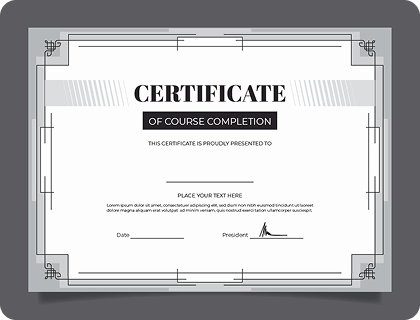
Showcase your skills with a certificate! Complete the course, submit your project, and earn your certificate. Here's a sample of what you'll receive to show off your accomplishments.
Course Curriculum
Open-access academic curriculum. All foundational lectures available to read free.
8 Chapters
•32 Lecture
•24h
1. AICPA Code of Professional Conduct: Independence Rules and Conceptual Framework
# AICPA Code of Professional Conduct: Independence Rules and Conceptual Framework ## 1. Deep Theoretical Foundations & Conceptual Framework The ethical architecture governing the certified public accounting profession in the United States is anchored in the **AICPA Code of Professional Conduct**. The Code provides both a philosophical framework and enforceable rules designed to preserve public tru...
45 minutes
2. SEC and PCAOB Independence Standards and Sarbanes-Oxley Act (SOX) Compliance
# SEC and PCAOB Independence Standards and Sarbanes-Oxley Act (SOX) Compliance ## 1. Deep Theoretical Foundations & Statutory Architecture The regulatory oversight of auditors auditing public reporting entities (issuers) underwent a structural paradigm shift with the passage of the **Sarbanes-Oxley Act of 2002 (SOX)**. Prior to SOX, the accounting profession was largely self-regulated under the au...
45 minutes
3. System of Quality Management: SQMS 1 and SQMS 2 Frameworks
# System of Quality Management: SQMS 1 and SQMS 2 Frameworks ## 1. Deep Theoretical Foundations & The New Quality Architecture In response to increasing complexity in business operations, rapid technological transformations, and persistent deficiencies identified during regulatory inspections, the AICPA Auditing Standards Board (ASB) overhauled its quality control regime. Effective December 15, 20...
45 minutes
4. Professional Skepticism, Due Professional Care, and Audit Documentation (AU-C 200 and AU-C 230)
# Professional Skepticism, Due Professional Care, and Audit Documentation (AU-C 200 and AU-C 230) ## 1. Deep Theoretical Foundations & Professional Standards Auditing is fundamentally an epistemic discipline: it is the systematic process of objectively obtaining and evaluating evidence regarding assertions about economic actions and events to ascertain the degree of correspondence between those as...
45 minutes
Academic Ecosystem & Connected Pathways
Deepen your studies across connected learning pathways in the PAMCET academic network:
Digital Research Library16,000+ open-access monographs & textbooks
Structured Learning PathsCurated multi-course career specializations
WAEC / SSCE Examination HubComplete secondary school syllabus & mock tests
JAMB / UTME PreparationComputer-based tests & scoring analytics
Tertiary & University Hub100L - 400L degree benchmark modules
Credential Verification PortalInstant cryptographic certificate authentication
Instructor
PAMCET Learning Team
Institutional Course Curation · PAMCET
Qualifications:
PAMCET Learning Team — Institutional Course Curation, Digitpen Hub LtdMy Skills:
- Curriculum Curation
- Course Content Review
- Learning Outcome Design
- Course Publishing & Quality Assurance
- Platform Content Operations
Reviews
No reviews available

Free$15100% Off
Certificate available separately for $5 after completionCourse Includes
8 Chapters
32 Lectures
2 - 4 weeks
Skill Level advanced
Taught in English
Lifetime Access
Certification of Completion
Category: CPA AUD: Auditing & Attestation
Share On
Download Syllabus & Study Guide
Receive the full lecture syllabus, reading list, and milestone schedule for CPA Exam Preparation: AUD (Auditing & Attestation).
By submitting, you agree to receive educational updates. You can unsubscribe anytime. Read our Privacy Policy.